

Well-Behaved White Women Seldom Make History, or Allies
White women's socialization often keeps them from working for the liberation they claim to desire

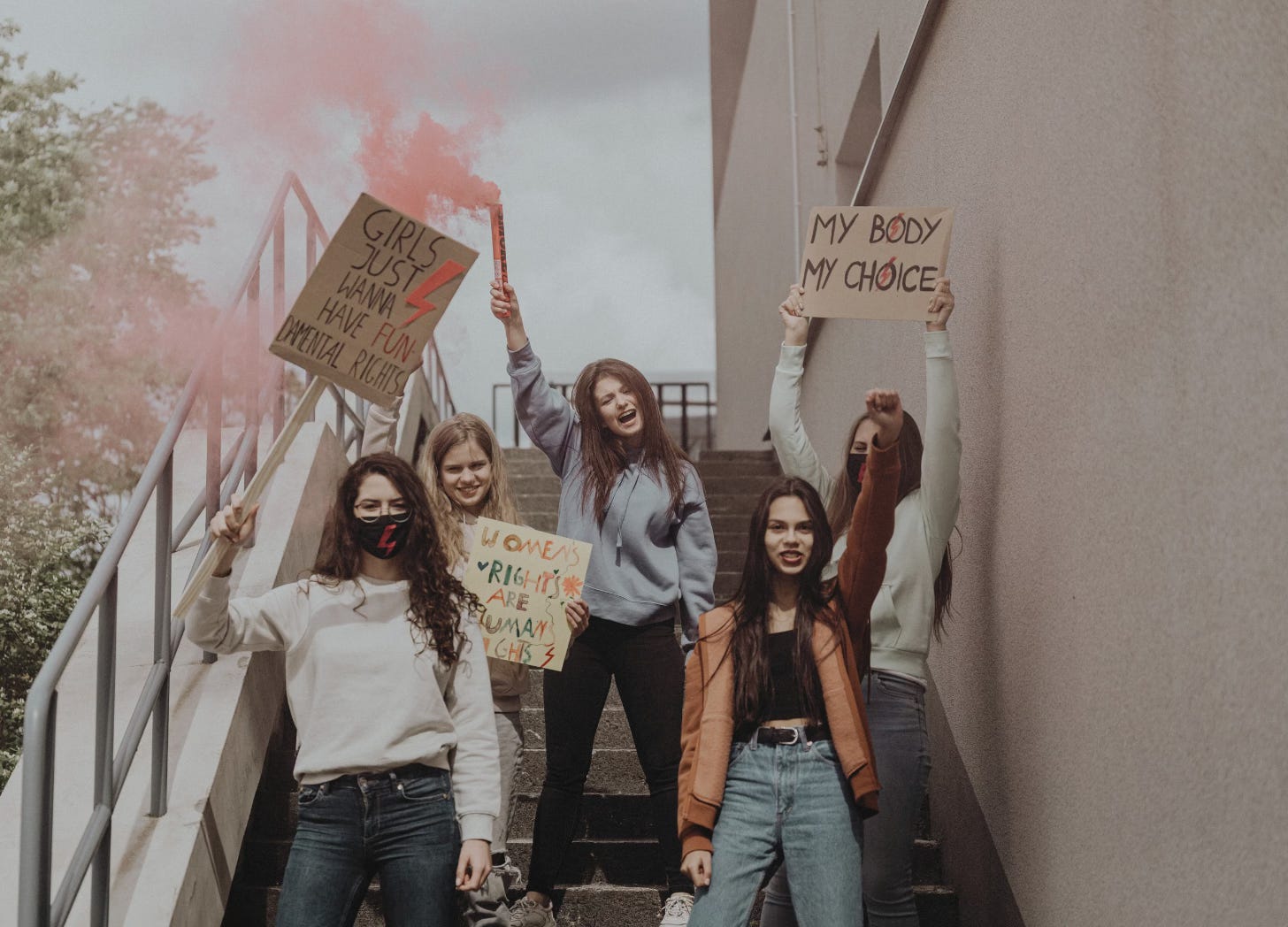
One of the biggest barriers that I’ve faced in addressing racism and sexism has been the silence and complicity of White Christian women. I’m not talking about conservatives; I expect them to work against racial-gender justice even when it goes against their personal interests. Rather, I am talking about White women who claim to be liberal or progressive…allies even. I’m talking about the White women who, in private or small group conversations, lament injustice and claim to want institutional and social change. But when the opportunity comes to stand up for change, they go silent. They claim to be afraid of systemic retribution, though they hold considerable privilege within the system. They wait for people in authority, especially White men, to give them permission.
Even when they dare to break with authority figures, they want Black women to lead the way. They look to us to speak up and challenge the system, even though we are far more vulnerable to the retaliation that they claim to fear. They want us to shield them while we take multidirectional hits from intersectional oppression. They expect us to comfort them as we are trying to recover and heal from the wounds inflicted by being in their institutions. They need us to affirm them as allies while they repeatedly fail to have our backs. They claim to want justice and equity but they don’t want to risk anything for it. They are especially unwilling to risk the disapproval of other White Christians.
White women claim to want justice and equity but they don’t want to risk anything for it. They are especially unwilling to risk the disapproval of other White Christians.
As much as White liberal Christian women love to proclaim that, “well-behaved women seldom make history,” they tend to value being well-behaved more than making history, more than advancing social change. They are more like the trad wives whom they criticize than they would like to believe. They still want to be good Christian girls.
White women in the United States have never broken the shackles of the cult of true womanhood, the dominant model of femininity for upper- and middle-class White women since the antebellum era. Barbara Welter documented the extent of this ideology through an extensive analysis of women’s literature, cookbooks, and hundreds of religious tracts and sermons published between 1820 and 1860.1 She identifies four cardinal virtues of true womanhood: piety, purity, submissiveness, and domesticity. A true woman was religious, passive, sexually innocent, polite, oriented to home and family rather than the outside world, and dependent upon men for support, protection, and guidance.
Most of all, a true woman was supposed to be submissive. As Welter wrote,
Submission was perhaps the most feminine virtue expected of women. Men were supposed to be religious, although they rarely had time for it, and supposed to be pure, although it came awfully hard to them, but men were the movers, the doers, the actors. Women were the passive, submissive responders. The order of dialogue was, of course, fixed in Heaven.2
White women – and women of other races who aspired to be like them – were socialized to follow male leadership, not to subvert it. Working for justice, however, requires subversion. It requires going against the norm, breaking the rules, and making people upset.
White Christian women are often incapable of working for the liberation of Black women and other marginalized peoples because they have not reckoned with their own oppression. Cherríe Moraga writes about this in the groundbreaking anthology, This Bridge Called My Back: “I have come to believe that the only reason women of a privileged class will dare to look at how it is that they oppress, is when they’ve come to know the meaning of their own oppression. And understand that the oppression of others hurts them personally.”3
It’s not a coincidence that Audre Lorde wrote her iconic essay just six months after engaging feminist theologian Mary Daly in debate about the latter’s exclusion, distortion, and trivialization of women of color in her book, Gyn/Ecology. Addressing the exclusion of lesbian and third world women’s experiences by White women, Lorde wrote:
Those of us who stand outside the circle of this society’s definition of acceptable women; those of us who have been forged in the crucibles of difference; those of us who are poor, who are lesbians, who are black, who are older, know that survival is not an academic skill. It is learning how to stand alone, unpopular and sometimes reviled, and how to make common cause with those other identified as outside the structures, in order to define and seek a world in which we can all flourish. It is learning how to take our differences and make them strengths. For the master’s tools will never dismantle the master’s house. They may allow us temporarily to beat him at his own game, but they will never enable us to bring about genuine change. And this fact is only threatening to those women who still define the master’s house as their only source of support.4
Too many White Christian women want to maintain residency in the master’s house that raised them. They are unwilling to do the work that it takes to pack their bags and move out. And they certainly cannot help Black women dismantle what they only want to redecorate. Black women need allies, and well-behaved White women seldom make good ones.
Did anything in this week’s post resonate with you? Join the conversation by leaving a comment below. I don’t always have time to respond, but I promise that I read every comment.
If you enjoyed this post, be sure to share, like, and subscribe (it encourages the algorithm to direct more traffic this way). I do a lot of my writing in coffee shops (locally owned, of course) so if you feel so moved (and are able), you can buy me a coffee or become a paid subscriber. Thank you for supporting my writing!
Barbara Welter, “The Cult of True Womanhood: 1820-1860,” American Quarterly 18 (1966): 151-174.
Welter, 158-159.
Cherríe Moraga, “La Güera,” in This Bridge Called My Back: Writings by Radical Women of Color, 4th ed., ed. Cherríe Moraga and Gloria Anzaldúa (Albany, NY: State University of New York Press, 2015), 28.
Audre Lorde, “The Master’s Tools Will Never Dismantle the Master’s House,” in in This Bridge Called My Back: Writings by Radical Women of Color, 4th ed., ed. Cherríe Moraga and Gloria Anzaldúa (Albany, NY: State University of New York Press, 2015), 95.
Yes, to all of this. We’re socialized to connect our resources to white men, instead of turning toward other women. It’s fawning on a massive scale. Your wisdom that we’ve never broken out of the cult of womanhood is so powerful. Thanks for all of this.
I have a lot to learn and I think of myself as an ally…still learning and
Still listening to your words Dr.